News

PIAST-Q system officially launched

On the occasion of World Quantum Day, a key step in the development of quantum technologies in Poland and Europe was announced. The PIAST-Q computer system has successfully passed acceptance procedures and has been officially launched at PCSS. This marks the unit’s full readiness to perform advanced computational operations.

Read more

PCSS representatives in the Collegium Da Vinci Employers’ Council

The Employers’ Council of Collegium Da Vinci in Poznań is an advisory body of the university, comprising business representatives, which helps align educational programs with current labor market demands. The university emphasizes collaboration with practitioners to ensure a high employment rate. Urszula Grygier-Soboń, Deputy Plenipotentiary of the ICHB PAS Director for PCSS matters, and Dr. Magdalena Baranowska-Szczepańska from the Cooperation and External Relations Department, have been appointed to the Council.

Read more

PIONIER-Q: Construction of Cross-Border Quantum Key Encryption Connections

A key stage in the construction of the nationwide quantum key infrastructure, connecting High-Performance Computing centers within the PIONIER network, has been completed. During the March meeting with the European Commission, the test results were successfully summarized, and a strategy for further expansion of cross-border connections was presented.

Read more

PIONIER Network: Connection to Vienna Internet eXchange Launched

Last week, a new PIONIER network connection to the VIX (Vienna Internet eXchange) peering point in Vienna was officially launched, marking a strategic step in the development of Poland’s network infrastructure. This key investment opens the door to direct data exchange with over 180 global operators and content providers, significantly strengthening the position of Polish science and the digital economy within the European IT ecosystem.

Read more

A modern quantum infrastructure connecting Germany, Poland, and Czechia is being developed

In March, the QKD Network Germany-Poland-Czechia project was launched, which aims to create a secure, attack-resistant quantum infrastructure (QCI) connecting the three countries in our region. This will be the most extensive network in Central Europe utilizing Quantum Key Distribution (QKD)—a technology for generating and distributing cryptographic keys that is resistant even to future threats arising from the use of quantum computers. The initiative strengthens the cybersecurity of the states, ensuring secure communication between public institutions, critical infrastructure operators, the scientific sector, and data centers. One of the project partners is PCSS.

Read more

GraviQ: Building Poland’s First Network of Mobile Quantum Gravimeters

Implementation of the GraviQ project has begun, aimed at creating innovative research infrastructure based on quantum mechanics phenomena. The initiative involves building and deploying Poland’s first synchronized network of mobile quantum gravimeters, opening new possibilities for precise monitoring of Earth’s gravitational field and detection of natural hazards.

Read more

„Bliżej Teatru”: an innovative model of scenic heritage digitization

The Polish Theatre in Wrocław, PCSS, and the University of Wrocław have begun working together to create a model system for digitizing theatre art archives. The project aims not only to secure unique collections documenting more than 600 productions created since 1945, but also to develop an innovative digital service for cultural institutions across Poland.

Read more

PCSS as a member of the consortium funded by a 13-million-PLN grant from the Ministry of Science and Higher Education (MNiSW)

The Polish node of the European research infrastructure E-RIHS ERIC has received a grant exceeding 13 million PLN from the Ministry of Science and Higher Education. These funds will secure the project’s development for the next five years. PCSS, as a key member of the consortium coordinated by Nicolaus Copernicus University in Toruń, is thus fulfilling its mission at the intersection of modern technologies, science, and cultural heritage protection.

Read more

AI Innovations and Networking: Report from Spark Demo Day and Business Mixer

An event combining Spark Demo Day and Business Mixer took place at the Łódź Special Economic Zone headquarters, where the Poznań Supercomputing and Networking Center (PCSS) presented its technological offerings. The meeting, organized on March 5, gathered over 250 companies from across Poland, serving as a platform for establishing strategic business relationships and showcasing solutions developed under the Spark 3.0 program.

Read more

PCSS supports the PRACE FENIX 2025 call for proposals.

As part of the ongoing PRACE FENIX 2025 call for proposals, the offer of available infrastructure has been expanded to include additional cloud resources provided by PCSS. This initiative aims to support European research projects requiring advanced computing services and to provide free access to modern IT technologies for the scientific sector.

Read more

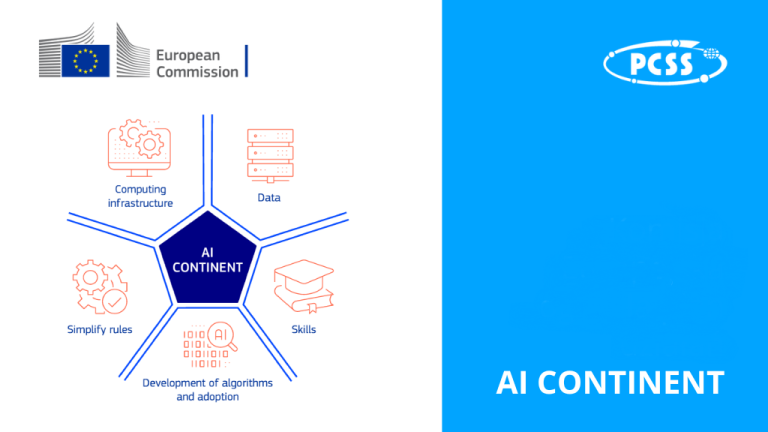
Poznań is ready for the AI Gigafactory – PCSS as a pillar of technological breakthrough.

Poznań is emerging as one of the pillars of artificial intelligence in Central and Eastern Europe, and the Poznańskie Centrum Superkomputerowo-Sieciowe (PCSS) plays a key role in this process. As the operator of the PIONIER network and the national leader in research infrastructure, PCSS is laying the foundation for the development of large-scale AI systems, combining unique expertise with the highest data security standards.

Read more

Inauguration of the UMWW Council for Artificial Intelligence

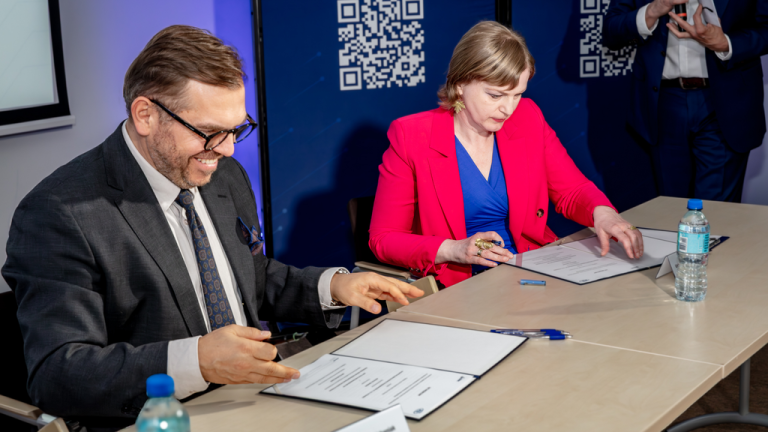
In the headquarters of the Marshal’s Office of the Greater Poland Voivodeship in Poznań, the activities of the Council for Artificial Intelligence were inaugurated. As an advisory body, it will support the processes of building a modern economy and administration based on AI foundations. The main goal of the established body is to develop innovative technological solutions, with particular emphasis on their practical application in the areas of healthcare, ecology, and public services provided to the region’s residents.

Read more